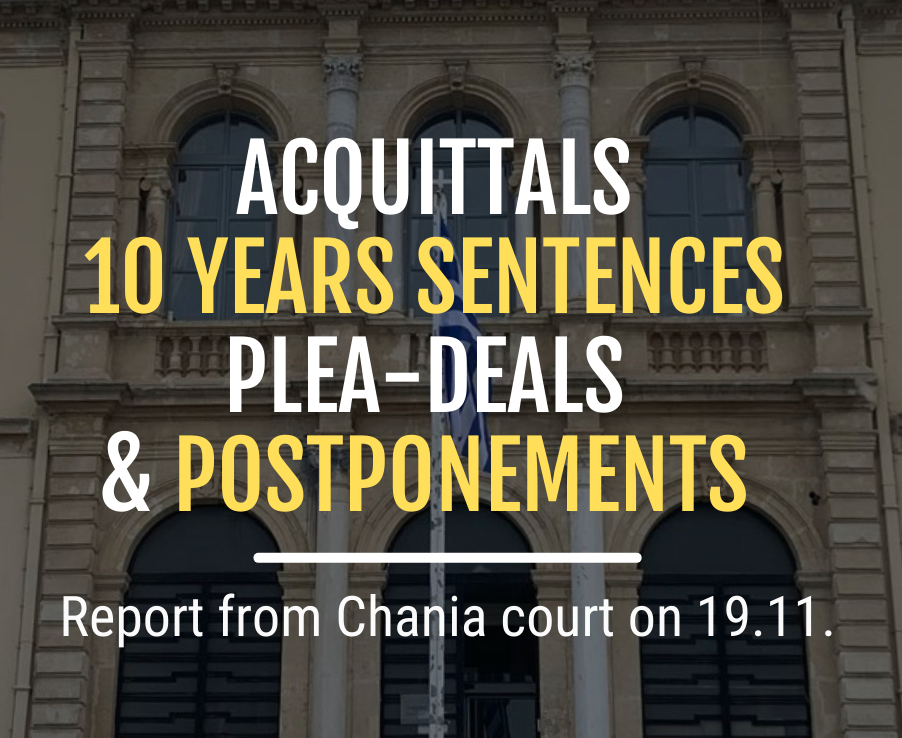
– Acquittals, 10 Years sentences, Plea-deals & Postponements
On the 19th of November 2025, we were present in Chania court to monitor “smuggling” trials together with our comrades from 50outofmany, Mataris Sudan Solidarity Comittee, Rosa Nera Chania, Steki Migrant Solidarity, Alma community center Athens and others. Many having fled war and atrocities in Sudan, others different kinds of hardship in their home countries, often experienced forced labour in Libya, they were arrested upon arrival in Greece and treated as serious criminals for having come here by so-called irregular, life-threatening routes. Authorities usually arrest at least one person per arriving boat, regardless of their actual role on board.
The court had scheduled 16 cases with 23 individuals for the day. Beforehand, us and our network were in touch with 14 of them. Most had trials originally scheduled for the 1.9., but were postponed until this day. Consequently, many of the boys and men in court on this day had already been imprisoned for 9 months or more. With the help of donations, we were able to finance lawyers for 8 individuals. However, that still leaves 15 people without access to a proper legal defence, and 9 that did not get in touch with solidarity networks earlier. Most of the people on trial were Sudanese, some from Egypt and other countries.
As is usual practice in Greek courts, the morning began with a chaotic people shuffling in and out of the courtroom, at least 16 of them being police officers in uniform, carrying weapons. The judge called out the names of those on trial, to assess who was present, and who had already been assigned a lawyer. Those who do not have the financing for a private lawyer, had not met their lawyers before, nor had a chance to discuss their case or receive any legal counselling. The judge assigned the present state lawyers to them on the spot, giving them only minutes to look into the thick folders of the cases and prepare their defence. There was no interpreter present, so the lawyers were not able to talk to the people they were supposed to defend prior to their trial.
A police officer from the court even acknowledged the absurdity of this practice, asking: “Shouldn’t they have met already in prison? Shouldn’t they have met before today?” A state lawyer waved off his concerns: “No, this is how we do it in Greece. It’s always like this.”
After around an hour and a half, a Syrian translator was found and brought into the court. The Syrian Arabic dialect is however far from the Sudanese one, and some of the defendants had to communicate in English with him, as they were unable to communicate in their respective dialect. Everyone has the right to defend themselves in their mother tongue, and receive explanation and legal counselling in this language. This right to proper translation is continuously denied to third-country-nationals defending themselves against “smuggling” accusations in Greece.
The time pressure for their cases and trials continued as the judge would repeatedly demand “Are you ready?” while the lawyers were still reading the file. Several people were brought to a separate room across the hall, where plea-deals are made before being presented to the judicial bench. Some of the discussions between the state-lawyers, translator, and defendants—none of whom had met before—appeared extremely rushed and pressured. Concerns remain that they may not have been fully informed about their rights and the consequences of a plea-deal. Having plead guilty, they cannot file an appeal anymore or ask for asylum in Greece.
By the end of the day, 4 people had agreed to a plea-deal, receiving 10-year sentences. Our Greek comrades made sure that at least minimal information was provided to them before being escorted out of the court room.
Already after the lunch break, the judge made clear that only 11 cases would be heard today, and the remaining 5 cases were postponed by another week until 24. 11.. For these 8 individuals, whose trials had originally been scheduled for the 1st of September, this meant another delay of their case being heard at all. Another week prolongs uncertainty and continues the unjust deprivation of their freedom. as they will remain in custody at Chania police station in the meantime.
The whole trial day, an overwhelming number of police officers filled up the room, remaining standing up opposed to all others who had to sit down. They stood in between us observers in the audience and the defendants, handcuffed to each other and their chairs, trying to avoid our contact with them. As these court days drag on for a whole working day, without a break or food for the defendants, some of us tried to offer some supermarket snacks. After a few failed attempts and denials, some police officers allowed the defendants they were responsible for to have a packaged croissant. However, others continued to refuse this basic right, simply stating that they “come from a different department” and giving no further reasoning as to why they would not allow the defendants under their supervision to eat.
The hearings with lawyers who were organized and financed by us and our network of solidarity actors ended up taking at least half an hour. One of the cases with three accused individuals took up the most time with over an hour (plus an interruption of another hour for the court to discuss). This may not sound long for a case in which the prosecution demands life-long sentences. However, it is already a stark contrast to those who did not have a private lawyer; their trials did not even last 10 minutes, while most received 10-year filakisi sentences.
In both cases financed by us, we were very happy that in total three people were acquitted!
This included a Sudanese father of two, represented by the Greek Council for Refugees, as well as two teenagers, Mubarak & Babakar Musa, represented by Spyridon Pantazis. The latter left us a comment on the trial:
“Today’s court decision is a clear vindication for our clients, who were wrongfully accused and spent many months in prison for something they never did. Behind these acquittals are human lives—families torn apart, people who endured the pain and insecurity of unjust detention. Yet today proves that justice, despite delays and difficulties, can rise to its role and safeguard the fundamental rights of all, regardless of origin or status. Nevertheless, we remain extremely cautious and vigilant, bearing in mind that dozens of Sudanese refugees remain detained.”
– Spyridon Pantazis, Lawyer of Mubarak & Babakar
For the father of two, his wife and two kids had travelled all the way from Northern Greece, already for the second time that his trial was scheduled. She testified that the family travelled together in the boat, that her husband was not a smuggler and that they fled a war and came to seek safety. Their kids were not allowed inside the courtroom, and therefore unable to see their father. We are overjoyed to see them reunited after this long and difficult time and able to live as a family again! For Mubarak & Babakar, we are glad that they get to live their youth outside of prison and get a chance at starting their lives in Greece.
However, while we are relieved that their completely unjustified detention is finally over – It is important to note that they were not acquitted for having driven the boat, but because the court believed it was not them who should be held responsible for the journey but someone else. Only in the case of the father was the court willing to acquit him despite acknowledging that he had driven the boat, as his wife testified that it was out of necessity. In both cases, their co-defendants were sentenced to 10 years filakisi. They too, should have been acquitted.
On a positive note – for the first time, the court accepted the birth certificate handed in by one defendant—confirming he is a minor. He will now be taken out of adult detention and await his hearing at the juvenile court. While we are happy it worked out in his case, this remains an exception. It is unacceptable that so many children are detained as adults based on the problematic and widely contested wrist-measurement method. Without this document, he would have been tried as an adult and kept in the same prison, severely violating his rights. This remains the case for many other young boys.
Moreover, arrests and trials continue almost daily. Over 2400 people are currently detained in Greek prisons on the charge of “smuggling”. Their trials often take place without adequate translation, without the chance of preparing a proper legal defence, without any witnesses heard or evidence reviewed. Life-long sentences are handed out within minutes. While the 19.11.25 can be considered a relatively successful day in the court in Chania, achieving three acquittals and the acceptance of one person’s minor status, this result also further reveals the completely normalized injustice that continues to be served during these trials. We will continue to be present at their trials, report on our observations and organize lawyers for those who are being charged with their own survival of the dangerous journeys to Europe.
If you can, please consider supporting with a small monthly contribution, so we can maintain stability and planning security in assisting those affected and imprisoned in European jails — instead of having to rely on last-minute fundraising and assigning lawyers at the very last moment.
Thank you!
On the 19.11.,
Garan David Garan,
Mohamad Mubarak Abdulrahman,
Mohamad Babakar Musa,
Dawud Mohamed,
Biel Muoch,
Musa Hamed,
Hamis Alladin,
Alsanosi Suliman Nasor,
Mmenir Khaleg Joker,
Elashri Lashri Unis Khaleg,
Thot Gatluit Chuol,
Matik Giew David Giew
and Adam Jolis Haroun
will be on trial in Chania.
Thot gatluit choul is only 15 years old,
and david matik giew is only 16 years old.
The Greek courts trial them as adults, despite a birth certificate being present. This is outrageous! Unfortunately, they do not have lawyers, as we lack the funds.
We hope that our presence in the courts and other positive outcomes can have an impact also on their trials. However, we need your support!