
Author: Sarah Babiker
Published on 2 April in El Salto(original in Spanish, translated to English by de:criminalize)
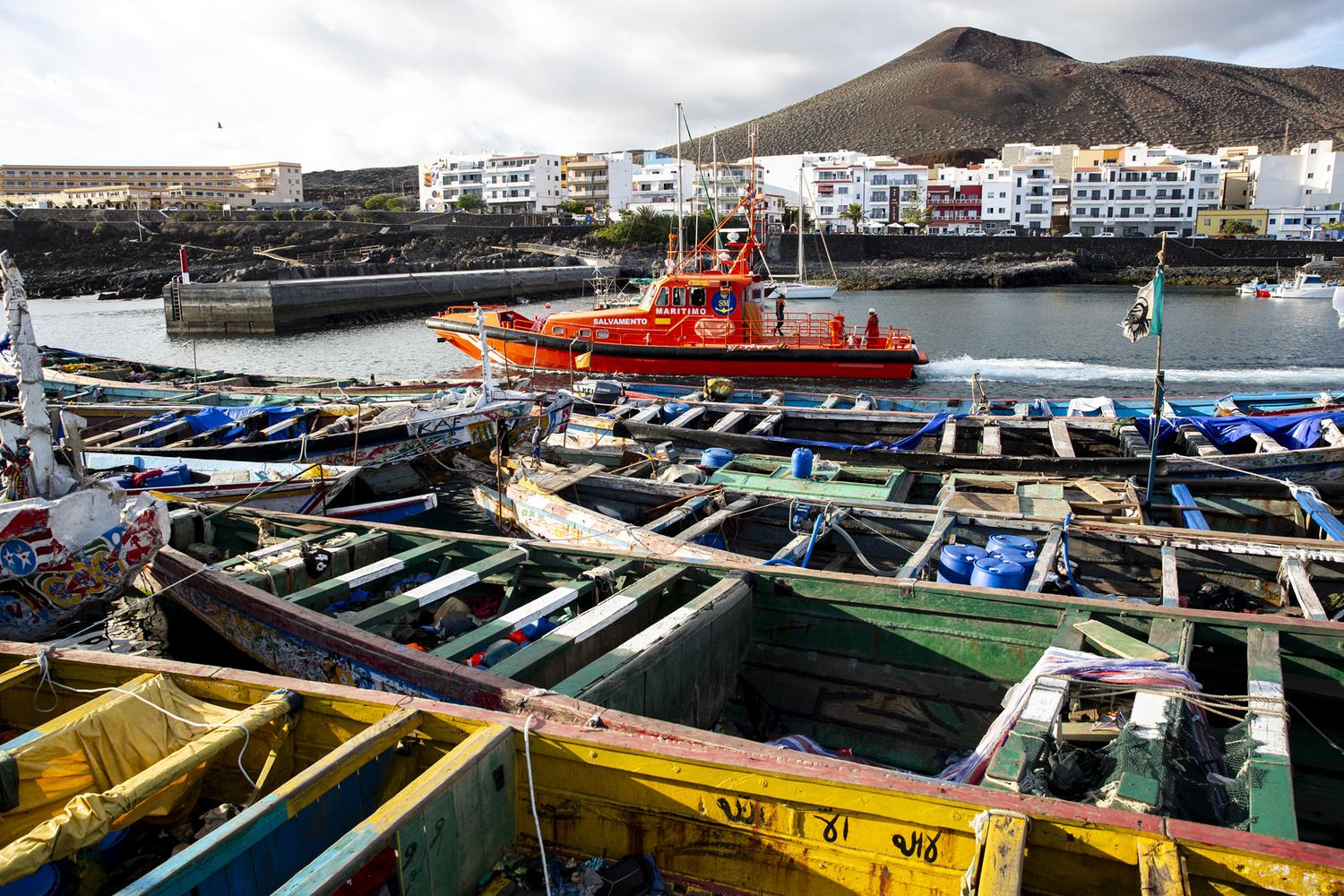
Baboye K., aged 32, arrived at the port of La Restinga on the Canary Island of El Hierro in June 2024. A year and a half later, in December 2025, he received news from the Sixth Chamber of the Provincial Court of Santa Cruz de Tenerife that he never imagined hearing when he left Mauritania: he was sentenced to more than seven years in prison. His offences, according to the ruling: facilitating unauthorised migration, manslaughter and causing injuries. Alongside him, two other young men suffered the same fate.
The text sets out the details of the charges against them: “Once on board, the three defendants (…) took turns carrying out essential navigation tasks such as steering the vessel and setting and maintaining the course, using at least one GPS device”. The ruling also finds them guilty of overcrowding on the vessel, the shortage of water and provisions, as well as the lack of life jackets. Finally, they are accused of the death of a Mauritanian man who died during the journey.
After a year and a half in pre-trial detention, Baboye has endured a second winter without warm clothes and in the cold, this time knowing that several springs await him behind bars. When he arrived on El Hierro in the summer of 2024, having survived six days at sea, Baboye was transferred, along with the rest of the passengers—a total of 47 people—to Las Raíces camp in Tenerife. There, he had an appointment with the police. The young Mauritanian recounts that when the interpreter and one of the lawyers from Accem (the organisation running the camp) handed him the police summons, he did not grasp the gravity of the situation. “I thought I was going to give a statement like the others; they told me nothing was wrong, they didn’t tell me anything else. Then in court, it was the same. I arrived and they asked me if I was the captain. I said no. Then they talked for a while and the translator didn’t translate anything for me; I didn’t know what they were saying.”
That day, Baboye was asked to sign a document. Although he didn’t understand it, he signed it believing it would allow him to return to the camp. “I only understood a bit of what was happening when I went to prison. They called in almost everyone from the boat, and us last; we thought it was for the same reason, but suddenly they put handcuffs on us and took us to the cell.” And so, on 16 July 2024, just a few days after arriving, Baboye found himself locked up. The young man explains that he had never been anywhere like this, nowhere even remotely similar. When he boarded the precarious boat that would take him to the Canary Islands, he never imagined he would be detained. “When I went to prison, I was still feeling ill from the journey; I was being treated by the camp doctor,” he recalls.

Portrait of Baboye K., provided by himself.
A criminal charge that could mean everything
Baboye’s account reached us via his lawyer, Sara Rodríguez Trigo. Rodríguez Trigo visits her client frequently; she is worried about him. He is not coping well with being in prison; his sentence is particularly harsh—the harshest in such cases over the last three years: it amounts to seven years and four months in prison—five years for facilitating unauthorised migration, two years for manslaughter, and four months for the offence of causing grievous bodily harm through gross negligence. By “these cases”, Rodríguez Trigo refers to the charges against people on the move for acting as boat drivers, or “captains”, as Baboye put it. People who, under Article 318 bis of the Spanish Criminal Code, are sentenced to years in prison following a trial without due process, according to complaints from legal professionals and activists. The Patrones Project, which aims to raise awareness of this situation, estimates that between 200 and 300 people are imprisoned annually in Spain after being accused of driving the boats.
Article 318 bis criminalises assisting a foreign national to enter or transit through national territory, in breach of the relevant legislation. The penalty is aggravated in cases of financial gain, if the individual belongs to an organised group facilitating the unauthorised passage of foreign nationals, and if the lives of those on the move are endangered. For Baboye’s lawyer, the way this criminal offence is applied is problematic:
“As interpreted by the Supreme Court, it could mean everything: the person who hands out water, the person who bailed water out of the boat, the person who steered the boat even just once, the person who spoke to the driver – all of them can be part of ‘the organisation’”. In response to this notion, she explains that most people who disembark from the boats say that the situation there is simply a matter of survival, that no one is in charge, and that there is no sign of this alleged ‘organisation’. Furthermore, she highlights the fact that there are no known cases of passengers filing complaints against the alleged boat drivers, claiming to have suffered harm as a result of their actions.
Rodríguez Trigo, who has spent years defending people on the move accused of being the captains of their respective boats, has been researching court rulings in recent years. She included this information in the appeal she has lodged against Baboye’s sentence, to demonstrate “how the court contradicts itself in the sentencing and how it imposes a harsher sentence than in all other cases”. The lawyer explains that, generally speaking, in this type of trial, the aim is usually to get the defendants to plead guilty — that is, to sign the ‘plea deal’ — and thus impose lighter sentences, of between two and four years, compared to the standard sentence, which ranges from four to eight years.
The problem is a fundamental one, Rodríguez Trigo argues, as these plea deals are often signed even though the cases could be defended. Furthermore, they do not usually result in a reduced sentence, because when the accused do not sign the plea deal and go to trial, they often receive a similar sentence. The lawyer deplores that the prosecution typically requests six-year sentences, even when no rigorous investigation is carried out into the crime being reported. Among the shortcomings she highlights are the failure to identify deceased persons, and the absence of expert assessments of the injuries sustained by victims, who are nonetheless questioned as witnesses to incriminate the alleged captains.
Baboye’s case also highlights other shortcomings, notes Rodriguez Trigo, such as the fact that the three defendants did not each have a state-appointed lawyer to handle their case individually – a common problem where a single lawyer is responsible for several defendants. “This practice undermines the right to a defence and to free legal aid and is exacerbated by the lack of time and resources in the courts and bar associations to provide specialist lawyers, as well as by potential conflicts of interest between those under investigation,” explains Rodríguez Trigo.
Endless contradictions
The court has the document that Baboye signed: a confession in which he admits to having steered the boat, although without receiving any payment in return. “Baboye is convicted based on this statement, which was made in violation of fundamental rights because it was not filmed and there is only the document signed by Baboye but without prior translation of its content,”, to this statement are added the testimonies of three witnesses “who did not even physically attend the trial and could not identify him in court, adding that one of them admitted that state officials offered him administrative benefits for testifying,” notes the lawyer. Regarding the person who died during the journey, the police record stated that Baboye had taken him to the back of the boat when he fell ill, a claim which the defendant also denies.
The lawyer summarises all the irregularities she has identified in the case against Baboye, and which she has observed on other cases: the exploitation of survivors of the journey suffering from post-traumatic stress, inconsistencies between what witnesses state in their various statements (i.e. police station, court, trial), serious errors in the translation of these statements, statements that “do not meet any of the legal requirements”, contradictory and incomplete testimonies, and a prosecution service that bases its case on statements riddled with all these shortcomings.
The lawyer also points out that no records are kept of the interrogations. For example, the police were unable to specify at the trial how many people were questioned in Baboye’s case, a detail that Rodríguez Trigo considers crucial: it is not the same to call three people to testify and have them point the finger at her client, as it is to call 25 and have only three point the finger at him. The lawyer also speaks of a lack of diligence, as other individuals also identified as the driver by witnesses, were not investigated.
In Baboye’s case, moreover, his lawyer claims that the sentence imposed is longer than usual and that it violates the principle of non bis in idem, which prohibits a person from being convicted twice for the same offence. In this instance, he has been sentenced to five years’ imprisonment as the boat driver, with the sentence increased due to the death of the passenger, and a further two years have been added for manslaughter. The problem centres on the criminal offence, as it is very broad and is interpreted against people on the move.
“Baboye is devastated and has suicidal thoughts. This sentence has been appealed and we are going to lose it,” laments the lawyer, pointing out that there are no precedents in the High Court of Justice for any appeal regarding such cases in the Canary Islands being upheld, and that she does not hold much hope regarding the Supreme Court either. “We will take it to the Constitutional Court and it will surely have to reach the European level,” notes Rodríguez Trigo. Meanwhile, the young man wonders about the meaning of his entire journey, expressing deep distress: “When I found out I was in prison, I started to lose my mind, to think negatively and have dark thoughts. I came here to seek a better future; I never thought I’d end up in prison. I regret coming.”
From the cayuco to prison
What has happened to Baboye is happening to many of the people on the move arriving in Europe who, having survived the journey, are accused of facilitating unauthorised migration. The European Union’s narrative, which places the “mafias” at the centre of the migration debate, turns those who steer boats or operate GPS devices into mere statistics on detained “smugglers”. From Greece to Spain, from France to Italy, each country has its own legislation, but they all share a very broad definition of the offence, which allows them to convict people on the move as alleged “smugglers”.
The Canarian lawyer Daniel Arencibia is well versed in this subject, which he has been documenting for years, providing statistics that enable other organisations, such as the Patrones Project, to track the scale of the phenomenon. According to data from the Ministry of the Interior compiled by the lawyer, between 2001 and 2023, 1,147 people were charged and tried as ‘smugglers’ in the Canary Islands, 528 in Ceuta, and 334 in Murcia.
Arencibia explains what the process generally entails for people upon their arrival on the islands, and how some of these people end up being accused and convicted to prison terms. Generally, it is Salvamento Marítimo Humanitario that spots the boat carrying people on the move on the high seas and tows it to port. Once there, the people receive initial care from the Red Cross. This organisation is mandated to identify vulnerable individuals, such as minors – information which, the lawyer points out, the police often ignore. After the Red Cross, Frontex arrives to interview the survivors.
The European agency’s actions are particularly controversial due to the timing of its intervention. “The Ombudsman had complained and stated that criminal investigations cannot be conducted during these interviews because people are in a vulnerable condition and, furthermore, have not received any legal advice; they do not know what they are revealing and what they are withholding, nor do they understand the consequences of speaking out or remaining silent,” recalls the lawyer.
But Frontex has ignored the complaints and maintains it does not conduct compulsory interrogations. The Ombudsman replied, however, as Arencibia notes, that those being interviewed are not in a position to know whether the interrogation is compulsory or not, and that no questions should be asked until a lawyer is present. Unfortunately, Frontex refuses to comply with the Ombudsman’s instructions, the lawyer concludes.
“Many people say that during these interviews their phones are taken away”. The Porcausa Foundation has carried out a study stating that these phones are subjected to Israeli software called Cellebrite, which is used to access the devices’ contents,” says Arencibia. He adds that whilst people on the move ask for their phones long after they have been confiscated, the police claim that they hand them over voluntarily “as if it were credible that someone arriving from a foreign country would hand their phone over to the police as soon as they arrive”.
The lawyer goes on to describe the sequence of events upon arrival on Spanish territory: After the interview with Frontex, people are taken “to a CATE (Temporary Care Centres for Foreigners) or a temporary detention centre where they can be held for a maximum of 72 hours for identification purposes”. A police station, Arencibia clarifies to leave no room for doubt, where they remain detained until, until the time limit has passed, then they are transferred either to the Foreigners’ Detention Centre, if they are to be brought before a judge, or to a camp, such as Las Raíces. Days later, as Baboye’s lawyer explained, the police begin investigations following the instructions given by Frontex.
“This is where the sensitive issue begins, because what we find when reading the police reports is that the police may arrive with an interpreter and meet only with a group of those who arrived.” What this implies: facilitating the accusation that someone is the captain of the boat. Arencibia suspects that they exploit the diversity on the boats to encourage passengers to accuse one another: “They ask only those from a particular country or speaking a particular language whether a third person was steering the boat. At first they always keep quiet, but then the police explain to them, ‘Let’s see, the law allows us to give papers—residence permits, work permits—to those who cooperate’.”
Arencibia has observed that when passengers share the same place of origin or language, it is easier for them to reach an agreement to prevent any one of them from being pointed out as the leader or organiser, and thus accused of smuggling: “It is important to reach these agreements on the high seas, as someone has to take the helm so that they don’t all die.” The problem arises when they do not all speak the same language: “The police know this and exploit that weakness,” deplores the lawyer. The situation is perverse: faced with the threat of being singled out as captains and consequently taken to trial, it is tempting to accuse others before they accuse you.
Thus, taking responsibility for ensuring the journey does not end in shipwreck – whether by steering the boat or helping to organise survival once at sea – puts a person at risk of imprisonment, as the authorities need to point the finger at someone to justify their claim that they are arresting smugglers, and they look for them amongst those who, like Baboye, are risking their lives to reach Europe. In this pursuit, the truth takes a back seat.
Arencibia insists that this is not just his own view; he points to an acquittal by the High Court of Justice of Murcia which “explains it very clearly, stating that all too often, rigour is abandoned in criminal investigations. The entire investigation is based on what one person says when accusing another person who was on the boat”, explains the lawyer, adding that this could lead to the boat driver accusing someone in order to protect himself. The lawyer emphasises the importance of the Murcia ruling: “A leading body in Spain is saying that rigorous investigations are not being carried out and that decisions on who goes to prison are being made by lottery.”
Fortress Europe deals out bad luck.
Baboye’s luck was not good; he signed a statement that nobody translated for him, and now he is in prison. His bad luck affects those around him, and that causes him even more frustration: “My family is very poor and they’re struggling. I’m worried about my mother’s situation and I can hardly get in touch with her from prison. They’re old and need me, but I can’t work to help them by sending money.” It is difficult for this young man to understand why he is being treated like a criminal; he fears that prison will end up stealing his future. “The laws in Spain lack clear justice. We need them to tell us things, to explain our rights to us.”
It does not seem that the issue of boat drivers is being addressed in terms of justice or rights, but rather, according to the criteria of those who perpetuate criminalisation, to achieve a supposed deterrent effect so that people do not migrate. “I don’t think they achieve any such objective,” notes Arencibia, “because the number of people who end up in prison is so marginal that it doesn’t influence the behaviour of people in Africa. They’d rather end up in prison in Europe, where they know they’ll survive, than stay in Mali thinking they might die.”
Perhaps people on the move who end up being charged with smuggling and imprisoned are quantitatively unrepresentative of the total number arriving on Spanish territory, but the consequences for those who find themselves in that situation are life-changing: people can face “up to eight years in prison”, notes the lawyer, “although the average is around three years”. The lawyer is referring to the offence of aiding and abetting; those like Baboye who are charged with manslaughter or causing grievous bodily harm receive sentences of between one and four years longer.
This is a reality that the United Nations Office on Drugs and Crime criticised in a monographic report on the Canary Islands route in 2022, confirming that it is not those who organise the journeys who are prosecuted, but people on the move themselves. “There isn’t a single conviction in which it has been established who took the money, because those on the boat are the passengers. So, if you put a passenger in prison, the organiser of the journey will send you another group tomorrow, and the day after that another group, and another,” the lawyer points out.
If the aim is to prevent people from arriving via unauthorised and dangerous routes, what is being done makes no sense, insists Arencibia, who believes the objective is something else: “it is very convenient for politicians and police commanders to be able to tell society: ‘we are fighting against unauthorised entry’”. At a time when migration control dominates the political debate, if you can say: ‘we have arrested 450 people this year for human smuggling’, you already have a message to send to society that you are not sitting idly by.”
In the lawyer’s view, this strategy is easier and more politically effective than the more complex, long-term investigative operations in which the authorities have to coordinate with police forces in other countries. On the other hand, the lack of transparency and public scrutiny helps perpetuate these kinds of practices, allowing them to be seen as an effective way of combating unauthorised migration: “the effectiveness that comes from not respecting human rights”, laments the lawyer.
A difficult but not lonely path
“My heart is completely broken. I feel I’ve been treated like an animal. It’s very cold now in winter and we have no clothes. They never take us to the doctor. We Africans in prison live like animals. We have no rights,” says Baboye from prison. Rodríguez Trigo shares her frustration at the sentence handed down to her client, interpreting it as a punishment for the young Mauritanian and, in a way, for herself too, for questioning the process. She believes the sentence was intended to “set an example”, and is distressed to see how her client has taken it: “He’s in a pretty bad way and, above all, he’s very nervous and anxious.” However, he receives no psychological support, and he still has a long time left in prison: “Until at least another year and a half has passed of the two years he has already spent in prison, the maximum period of provisional detention will not have been served. If the sentence had been the usual one in Tenerife, then he could be out whilst we appeal.”
It is not easy to fight these cases; Rodríguez Trigo is self-employed, works pro bono and at affordable rates, both with the families of these individuals and in collaboration with other NGOs that occasionally fund the legal defence. The Patrones Project and the de:criminalize collective —two groups of activists specialising in supporting people on the move criminalised as alleged boat drivers— are assisting her on a journey that began long ago, as she is currently undertaking a PhD in criminal law on boat drivers: “The PhD hypothesis is to demonstrate that there is systematic and very serious institutional racism when it comes to boat drivers.” “Rights violations,” she explains, “are justified by the alleged lack of resources whilst exploiting the vulnerability of people on the move, who have no roots, cannot afford legal representation, or are unaware of their rights.”
“The influx of arrivals, the lack of resources – whether from the police, the justice system or lawyers – combined with the racial and contextual bias inherent in this type of crime, create the perfect storm leading to proceedings that should be null and void, yet which result in the conviction of hundreds of people every year,” notes Rodríguez Trigo, who adds that defending the boat drivers brings neither financial reward nor satisfaction: “It is a battle that is lost before it even begins. Although, prior to the Baboye ruling in 2025, we have secured very positive acquittals in Tenerife, there is still much work to be done to ensure that changes are implemented right from the police investigation stage.”
From the Patrones Project, activist Inés Marco also points out that their aim is to train bar associations, and welcomes the fact that the network is expanding as visibility is given to a situation affecting so many people whose life plans collide with the most punitive version of Fortress Europe.