
Inés Marco Coordinator of the Patrones Project and member of De:criminalize
Every year, dozens of people on the move are accused of steering the boats on which they arrive in the Canary Islands. Upon arrival, a mechanism is set in motion – involving both Frontex and the Spanish authorities – which effectively leads to their conviction. A mechanism based on the denial of all their rights. The Freedom of Movement Fund has been set up to ensure an adequate legal defence and to put an end to the mass incarceration of people on the move.
Baboye Kan is 32 years old. He was born in Mauritania. He arrived on the island of El Hierro (Canary Islands, Spain) on 24 June 2025, after sailing for six days in a precarious boat, and was arrested 20 days later. A year and a half later, he was sentenced to 7 years and 4 months in prison. Baboye was not convicted of “facilitating migration”, but also of manslaughter and causing grievous bodily harm, as one man died during the journey and two people were admitted to hospital. During one of the interrogations, Baboye was asked to sign a document that had not been translated. Now we know that it was a self-incriminating statement. One of the witnesses who testified at the trial admitted that he had been offered administrative benefits in exchange for his testimony. Baboye’s sentence is currently under appeal.

Portrait of Baboye, Kan, provided by himself.
The story of Baboye sadly is exemplary. At all European borders, including those of countries with which the EU has signed border externalisation agreements, hundreds of people on the move are imprisoned every year on charges of “facilitating unauthorised migration”. The mere act of steering the wheel during an unauthorised border crossing, handing out water or food, or repairing the engine is deemed sufficient to accuse them of participating in the organisation of the border crossing. In reality, the very act of crossing a border carries the risk of criminalisation, because practically no evidence is needed to accuse and convict any of the people involved. At every border crossing – alongside those who die or suffer injuries – the lives and dreams of one, two or three people accused are swept away into prison. So-called anti-smuggling laws are a machine for imprisoning those who dare to challenge the borders of Fortress Europe.
Within this framework of systematic criminalization, the Canary Islands are no exception. Located 100 kilometres from the African mainland and 1,300 km from the southern coast of Spain, the fact that they form part of the African continent has made the Canary Islands one of the main routes of entry into the European Union. Tighter border controls on the shorter and relatively safer routes, such as the ‘Strait of Gibraltar route’ or the ‘Alboran route’, led to an increase in transit on the so-called ‘Atlantic routes’ from 2020/2021 onwards. Of the 33,000 people who arrived in Spain by sea in 2025, more than half (54%) arrived in the Canary Islands. Although the point of departure was initially the coasts of Western Sahara and Morocco, increased border controls have, once again, led people to begin their migration journeys from more distant areas, such as Mauritania, Senegal, Gambia or Guinea. The Atlantic routes are considered one of the most dangerous in the world. The organisation Walking Borders estimates that at least 1,906 people went missing or died during the journey in 2025 – that is, one in ten of those who set out on the journey.
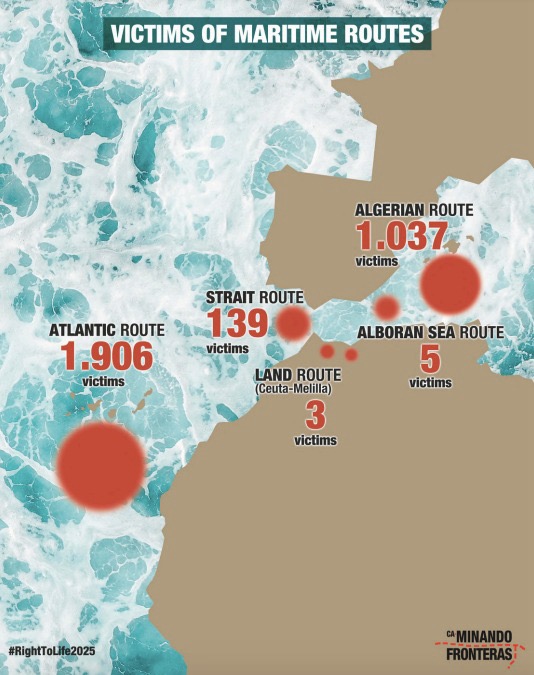
Infographies from the report “Monitoring the right to life – 2025” by Walking Borders.
When survival means losing your freedom
In addition to the risk of not surviving the journey, there is also the risk of being detained on arrival. The Canary Islands are one of the regions with the highest number of arrests of alleged “boat drivers” (“patrones” in Spanish); in 2024 alone, 110 people were arrested, mainly from Senegal, Mauritania or Mali. Although the extent of criminalisation along the Atlantic route is similar to that in other border regions in the south of the European Union, primarily Greece and Italy, both public awareness of this reality and the existence of solidarity networks are relatively low. What are virtually identical, however, are the violations of the rights of people on the move that occur.
Civil society organisations and lawyers report that the rights of the people accused, as well as those of other passengers, are violated both during investigations and throughout the judicial process. Each and every irregularity detected leads in the same direction: the systematic conviction of the accused. Given the virtual absence of procedural safeguards, once charged with a crime, they have very little chance of being acquitted. The imprisonment system is highly efficient: between 2018 and 2024, amongst all those charged in the Canary Islands, 80% pleaded guilty and 10% were convicted during trial. Thus, 9 out of 10 people arrested end up serving a prison sentence.
There are many reasons why the vast majority of people end up pleading guilty, -a distinctive feature of the Canary Islands in the context of criminalisation in Europe-, and so many others are convicted at trial, but there is one key factor; the impossibility of accessing an adequate defence. The circumstances are challenging from the outset: they face a racist political and judicial system with a major interest in convicting them; they have no family or community network in Spain; they do not speak the language and do not have access to adequate interpreters; and they lack sufficient financial resources. Hiring a lawyer is nearly impossible, and without lawyer they are practically convicted.
Mamadou experienced this situation first-hand. He had been in pre-trial detention for a year and a half. The public prosecutor was requesting six years for facilitation of migration, four years for manslaughter, since one person died on the journey, and two and a half years for causing bodily harm through negligence. He was facing a sentence of more than 12 years. He had not met his state-appointed lawyer. Through the Freedom of Movement Fund, organised by Medico International and managed by the collective De:criminalize, a specialist lawyer was supported to take on his case. Mamadou was acquitted at trial.
Given the large number of procedural irregularities committed during the investigation and the lack of evidences to substantiate the charges, there is a reasonable chance of obtaining an acquittal or a substantial reduction in the sentence when a specialist lawyer takes on the case. Unfortunately, however, this type of criminalization is so extensive that there are not enough resources to support all those affected. Thus, in addition to providing direct support to specialized lawyers through the Fund, one of the intervention strategies is to raise awareness about the huge amount of irregularities and the total lack of safeguards during these proceedings.
A trial without law
Although each case has its own distinct characteristics, there is a common pattern and certain rights violations that occur repeatedly. The severity of the failure to enforce existing laws suggests the existence of a system of judicial apartheid, in which individuals accused of being boat drivers are tried in a virtually parallel justice system that offers no safeguards. Below, we aim to highlight some of these structural violations in cases of criminalization in the Canary Islands, with the intention of providing an overall picture of the mechanisms that are set in motion from the moment the boat arrives and that, in most cases, culminate in prison sentences for the defendants.
Human rights violations also affect all survivors of deadly migration journeys, who become, first and foremost, potential witnesses and the basis for the prosecution. The questioning of survivors to determine who was responsible for steering the boat– in which both Frontex and the Spanish authorities are involved – begins shortly after their arrival, a practice that the Ombudsman had already criticized in 2023 for different reasons, although nothing has changed since then. Firstly, survivors find themselves in a highly vulnerable situation after having spent several days or even weeks at sea, and having perhaps witnessed the deaths of other passengers; as a result, they are not in a suitable physical or mental state to undergo interviews or to give their consent. Moreover, the Ombudsman also noted that neither court-appointed lawyers nor interpreters were present during these interviews.
Furthermore, lawyers specialising in the criminalization of “boat drivers” report that during these interrogations, survivors are offered residence and work permits in exchange for accusing someone of having driven the boat or contributed in any other way to their collective survival. Although Spanish criminal law generally provides for such agreements, it limits them to a narrow context and to specific safeguards designed to prevent coercion. It is precisely these safeguards that are missing in reality.
In most trials, the incriminating statements obtained through these tactics will be the only evidence against the defendants, which contravenes the case law of the European Court of Human Rights, which has been upheld by the Spanish Supreme Court. Once sufficient statements have been obtained to support the charges, the individuals who have been identified are arrested and imprisoned. From that point on, they usually spend long periods in pre-trial detention, averaging one year but often extending to 18 months. During this time, they are frequently isolated from their families, since obtaining permission to call them from prison requires going through bureaucratic procedures that are impossible for many, and they have no means of contacting their state-appointed lawyers. Consequently, the psychological state prior to a plea bargain or trial is one of extreme stress and anxiety.
The first contact with the court-appointed lawyer usually takes place at the meeting where a plea bargain is negotiated. There is little or no time to prepare and present the case, and lawyers usually recommend pleading guilty in order to secure a reduced sentence. The Prosecution has a simple strategy to ensure that defendants plead guilty: they offer a three-year prison sentence for the charges of facilitation if they plead guilty, and between six and eight years if they wish to go to trial. To this must be added the years of imprisonment if there are other charges, frequently manslaughter or causing bodily harm. Defendants are often not informed of the consequences of pleading guilty, which include, amongst other things, that they will not be able to regularise their administrative status in Spain until 5 years after serving their sentence because of having criminal records.
This is how prisons are filled with people on the move –who may or may not have steered the boat or distributed water or food – but who will certainly end up boosting the statistics on “people’s smugglers” convicted by the Spanish authorities. Statistics that will be used to justify that “they are doing something” whenever migration policies – the very ones they themselves design and implement – cause more and more deaths at the borders. And that is why, instead of asking who is involved in the project of those who decide to move, we should focus on what matters: that migration control policies force people to migrate via deadly and inhumane routes; that migrating is not a crime and therefore neither should facilitating migration be; and that it is urgent to put an end to the mass incarceration of those who are fairly exercising their right to freedom of movement.

Cayuco in the port of La Restinga (El Hierro) (Leticia Marthe)